

Let’s find your next opportunity
AI Assistant: {{ chat.assistant.message }}
{{meta?.totalCount}}
results found
Sort By
{{ job.job_posting_title
}}
{{ job.job_posting_title }}
{{ job.is_cms_job ? (job.cities.split(';').length > 1 ? 'Various locations' : job.location_mappings[0]) : (job.location_mappings.length > 1 ? 'Various locations' : job.location_mappings[0]) }}
{{ job.time_type }}

We are sorry there are no jobs that match your exact criteria. Try a new search term, or use the filters to continue browsing for available opportunities.
Suggested roles matches
{{ job.title }}
{{ job.title }}
{{ [job.cities[0], job.regions[0], job.countries[0]].join(', ') }}
Various locations
We are sorry there are no jobs that match your exact criteria. Try a new search term, or use the filters to continue browsing for available opportunities.
Let’s find your next opportunity
{{ job.job_posting_title
}}
{{ job.job_posting_title }}
{{ job.is_cms_job ? (job.cities.split(';').length > 1 ? 'Various locations' : job.location_mappings[0]) : (job.location_mappings.length > 1 ? 'Various locations' : job.location_mappings[0]) }}
Sarah, Air Quality UK Practice Lead at AtkinsRéalis and Chair of the Institute of Air Quality Management, on the discipline at the intersection of science, policy and public health.
Sarah remembers exactly when she first cared about the air.
“It was during a Biology GCSE class on the effects of man-made greenhouse gases on the earth’s atmosphere,” she says. “From there, my curiosity built around how pollutants are formed and transformed.”
That curiosity led her to study Chemistry at Bristol, and work for a year in a laboratory at the National Physical Laboratory. After a while she realised she wanted to apply science in a business setting, so took the Environmental Technology MSc at Imperial, which led on to her finding a job in consultancy at WS Atkins in 2000. Twenty-five years later, she leads AtkinsRéalis’ UK Air Quality practice and is a Fellow of the Institute of Air Quality Management (IAQM).
It’s the kind of career that doesn’t follow a single track. From assessing a Sicilian road scheme to dispersion modelling aluminium production in Qatar, from mentoring early-career colleagues to presenting evidence at a public inquiry, Sarah has built a portfolio that reflects how the discipline itself has evolved.
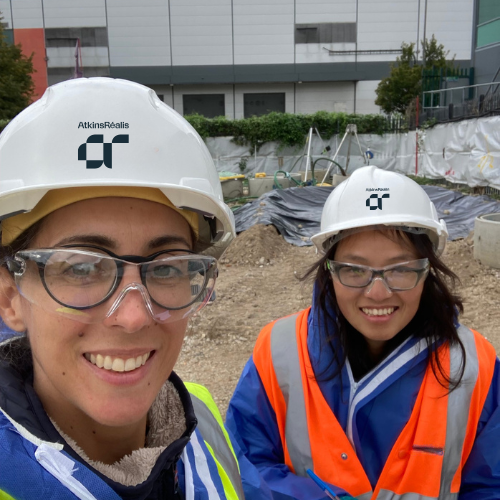
Why air quality matters
“Air quality sits at the intersection of science, policy, and people’s lives,” Sarah says.
That intersection is broader than most people realise. Air pollution affects the growth of children’s lungs and damages multiple organ systems, particularly within vulnerable populations. It damages plants, reduces crop yields and acidifies soil. Some pollutants drive climate change, which in turn changes how other pollutants behave.
“And what we know about pollution, who is affected by it, what pollutants we need to be concerned about, is continually evolving as new research comes out. Meanwhile the opportunities to do something about it continually change too, as technology and politics moves at pace.”
For Sarah and her team, that means helping clients find solutions that prevent harm before it happens, supporting developers to gain permission to build and operate sustainably, and supporting Government in regulating pollutants and processes.
There’s no such thing as a typical day
Ask Sarah what an average week looks like, her answer is both precise and varied.
In a single week she might start in the office reviewing dispersion modelling outputs, then heading out to a construction site auditing contractor methods or meeting clients to present air quality monitoring findings, liaising with legal teams, bidding for new work, exploring emerging pollutants or mitigation technology, or helping team members navigate complex projects.
Once a year, she even has her nose “calibrated” to check her sense of smell.
It’s the kind of variety that makes the role both demanding and genuinely interesting, it’s also a useful signal for anyone wondering whether environmental consultancy is too narrow a field. The reality, in Sarah’s case, is closer to the opposite.
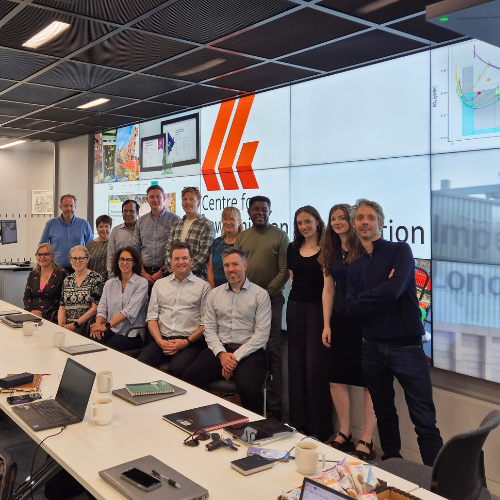
The work that closes the gaps
Ask Sarah for a proud moment, and she’ll tell you about a piece of guidance she’s recently developed for the IAQM.
A regulatory and knowledge gap had been resulting in weak planning conditions for brownfield site redevelopment, with shortfalls in contractor commitments to mitigation and monitoring. This was increasing risk to public health and wellbeing beyond site boundaries.
Drawing on her scientific understanding of pollutant sources, atmospheric behaviour, exposure pathways and years of work on former gasworks sites, Sarah led a working group at the IAQM to produce new guidance; providing consultants, regulators and developers with clear examples of good practice for monitoring air pollutants and mitigation.
“This supports the sustainable redevelopment of brownfield sites by underpinning the need to prevent emissions at source,” she says. “It has also led to developers taking a broader view of health, including toxicological effects and wellbeing.”
It’s a quietly powerful example of what air quality leadership looks like, not just delivering technical projects, but shaping the standards those projects are measured against to improve the experience of local communities.
A team that pulls together
If you asked Sarah to describe her team culture in three words, here’s what she’d say.
Collaborative - “we pull together to deliver a quality product, including reaching out across different technical disciplines to find the best person for the job.”
Supportive - “a problem shared is a problem halved, so we don’t let our colleagues suffer on their own when dealing with a challenging project or demanding client.”
Nerdy - “we always enjoy a group discussion about trends or anomalies in datasets, or finding out about how best to plot something in GIS.”
The third one might be the most telling. There’s a quiet confidence in being a team that admits, openly, that the science is the fun part.
Opening doors
In 2024, Sarah was awarded Fellowship of the IAQM. She was the youngest in a cohort of fifteen, only a quarter of whom were women. Then at the start of 2026, she was elected as Chair of the IAQM.
“This is something I am incredibly proud of achieving, and I am committed to inspiring more of our members to take the steps to apply and gain this title,” she says.
That commitment shows up in how she works: mentoring early-career colleagues, championing women in STEM; strengthening the IAQM’s professional competency frameworks and procedures so that the standards practitioners are measured against keep rising.
“As employees of AtkinsRéalis we have the opportunity to open doors for underrepresented talent and help shape a more inclusive profession, making a sector-wide impact in a challenging industry.”
It’s a fitting note to end on. Sarah’s career has been built around setting standards, for what good air quality work looks like, for what professional excellence demands, and for who gets to be at the table when those standards are written.
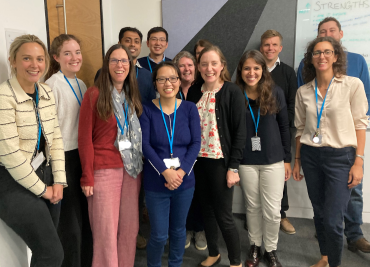
Working with Sarah
The Air Quality practice at AtkinsRéalis works across many markets, from road, rail and air transport to energy, power and industry. If you’re thinking about a career in air quality, environmental science, or the broader intersection of science, regulation and public health, Sarah’s team is one to know.
Ready to make an impact on the world around you? Discover Environment & Air Quality careers at AtkinsRéalis or join our talent community today.
Related blogs
Sam on turning climate science into practical decisions
Meet Sam, a Principal Climate Adaptation Consultant helping clients navigate climate risk with confidence.
It's about more than what we build
Meet Ellie and read how she turns infrastructure projects into real opportunities for people and communities.
Tomasz on building a squiggly career in International Urban Development Advisory
Meet Tomasz and discover how embracing new opportunities can shape a truly global career path.
From music technology to acoustic consulting: Amy on building a career in environment digital
Discover how Amy is turning technical knowledge into real-world impact through acoustics and digital solutions.
25 years in flood risk: Tony on building a career at the intersection of science and infrastructure
Discover Tony’s journey from graduate to Associate Director, read how he’s built a career protecting communities from flood risk.
From Aberdeen to Air Quality and Carbon: Bhajan on building a dual role in Environment
Meet Bhajan, an environmental consultant stepping across air quality and carbon, and discover how he’s driving real sustainability impact.
Step out of your comfort zone and build relationships: Jo looks back at twenty-five years with AtkinsRéalis and what has shaped her career
Discover Jo’s journey from volunteer work in Soweto to leading major UK planning projects. Read how courage and collaboration defined her path.
From policy to pinch-me moments: Anna on natural capital, neurodivergence, and never following a straight line
Discover Anna’s path from policy to practice, where impact, authenticity, and a non linear career come together.
Finding my place in the environment: a journey through people, places, and purpose
From anthropology to infrastructure, my journey hasn’t been traditional — but it’s been meaningful. Here’s how I found a role where people come first.
How I became a project coordinator in the ecology and environmental sector
I don't have a degree, but I built an ecology career I love in a brilliant team. Here's how!
From environmental scientist to technical director: My career journey in water quality
Here's what I've learned – and what might help you – while building a meaningful career in water.
Growing my career as an assistant environmental scientist at AtkinsRéalis
How I turned a Year in Industry placement into a thriving environmental science career
Related jobs

Everyone belongs
We empower each individual to shine and contribute to our collective impact. We believe in the power of unique perspectives. It’s how we’re engineering a better future every single day.